


Crossing Borders Does Not Guarantee Safety: Lessons from Mamta Kafle’s Tragedy
Rudra Dahal
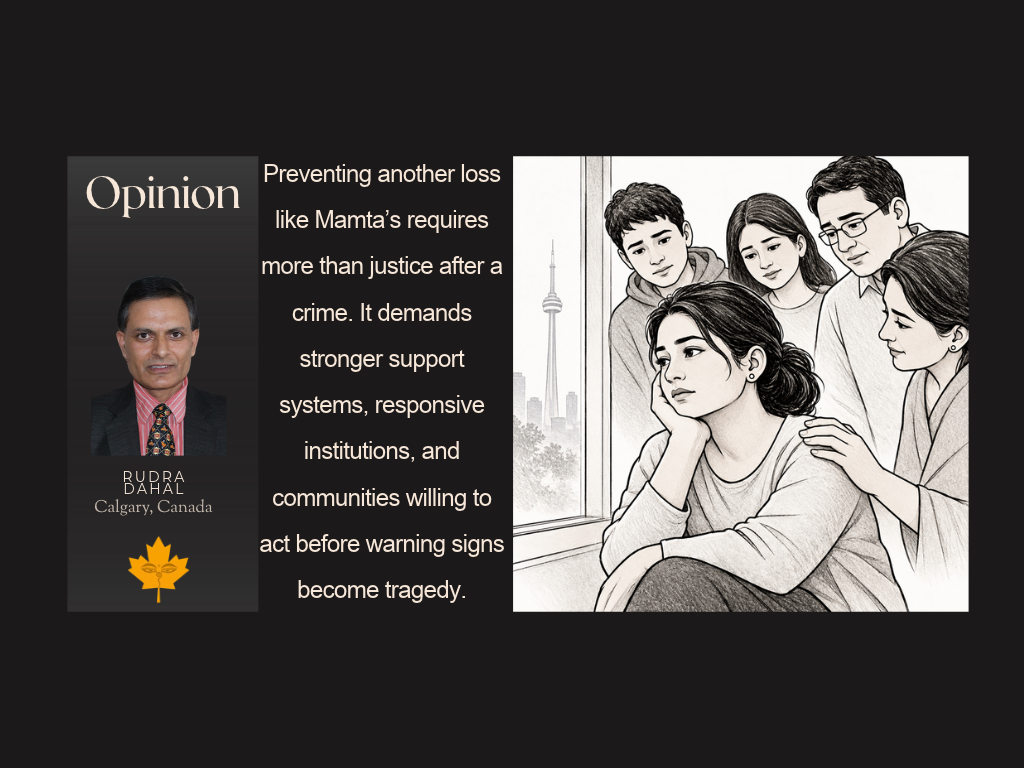
The tragic case of a Nepali nurse in the United States reminds us that migration does not automatically guarantee safety, independence, or freedom from violence. Preventing another loss like Mamta’s requires more than justice after a crime. It demands stronger support systems, responsive institutions, and communities willing to act before warning signs become tragedy.
The conviction of Mamta Kafle Bhatt’s husband for her murder in Virginia delivers a measure of accountability, but it offers little comfort for a life lost too soon. Mamta, a Nepali nurse, daughter, sister, and mother, disappeared in July 2024. More than two years later, a jury found her husband guilty of first-degree murder and related offences. Yet her remains have never been recovered, and her young daughter must grow up without her mother’s love, care, and guidance.

The verdict is important, but it cannot reverse the loss suffered by Mamta’s family and loved ones. More importantly, her case compels us to look beyond the courtroom and ask difficult questions. What happens when a woman migrates abroad seeking a better future but experiences violence within her own home? Who notices when she becomes isolated? What happens when concerns about her safety emerge? And what responsibilities do families, communities, employers, and public institutions have to protect women before violence becomes irreversible?
Mamta’s story is not only about one family’s tragedy. It is also a stark reminder of the vulnerabilities many women face and the collective responsibility we share in preventing violence before it turns deadly.
Migration does not automatically bring safety
Migration is often associated with opportunity, financial stability, education, and a brighter future. For many Nepali women, moving abroad may also represent independence and the hope of building a better life. However, crossing borders does not automatically provide protection from violence within the home.
Immigrant women can face unique challenges, including limited social networks, unfamiliar legal systems, language barriers, financial dependence, and concerns about immigration status. When abuse exists within a relationship, these challenges can make seeking help significantly more difficult.
Reports surrounding Mamta’s case suggest she had expressed concerns about her safety and reportedly experienced controlling behaviour, including restrictions involving personal documents. Her experience illustrates how abuse can extend beyond physical violence to include control over finances, mobility, communication, and access to support. Such forms of coercive control can leave women feeling trapped even when they live in countries with strong legal protections.
For this reason, domestic violence should be recognized not only as a criminal justice issue but also as a migrant health, safety, and human rights concern. A woman's immigration status, financial circumstances, or dependence on a spouse should never determine whether she can access protection and support.
Domestic violence is not a private family matter
While migration can increase vulnerability, another major barrier to safety is the belief that family problems should remain private. In many societies, including within Nepali communities, concerns about family reputation, marital commitment, and social expectations can discourage women from speaking openly about abuse.
Too often, women are encouraged to be patient, compromise, or preserve the family at all costs. Although such advice may be well intentioned, it can unintentionally place women at greater risk. Protecting family honor should never come at the expense of personal safety.
Domestic violence is not simply a disagreement between spouses. It can involve intimidation, coercive control, emotional abuse, threats, isolation, financial restriction, and physical violence. Over time, these behaviours can erode a woman's confidence, independence, and ability to seek help. A healthy relationship cannot be built on fear, humiliation, or control. The first responsibility of families and friends is therefore simple but crucial: listen without judgment, believe women when they express concerns, and take those concerns seriously.
Warning signs should never be ignored
One of the most heartbreaking aspects of Mamta’s case is that concerns about her safety reportedly emerged before her disappearance. According to media reports, she had shared fears with people she trusted and had reportedly sought help regarding domestic conflict.
These details highlight a difficult reality: violence rarely exists entirely unseen. Friends, family members, neighbours, colleagues, and healthcare professionals may notice warning signs long before a crisis occurs. Unexplained injuries, fearfulness, withdrawal, anxiety, sudden behavioral changes, or restrictions imposed by a partner can all signal potential danger.
However, recognizing warning signs is only the beginning. Meaningful action must follow. Too often, disclosures of abuse are met with doubt, blame, pressure to reconcile, or questions about why a woman does not simply leave. Such responses can deepen isolation and discourage future help-seeking.
Instead, survivors should be met with compassion, support, and information about available resources. The goal is not to investigate or confront an alleged abuser, but to help women connect with trained professionals who can assess risks and support safety planning.
Social connection can be a form of protection
For many migrants, social isolation is more than loneliness. It can become a serious safety concern. A woman who has recently arrived in a new country may have limited access to trusted friends, extended family, transportation, or community support. If an abusive partner controls communication, finances, or social interactions, isolation can become even more severe.
Mamta’s case demonstrates the importance of community connections. Her colleagues and friends played a vital role in raising concerns when she could no longer be contacted. Their actions remind us that strong social networks can provide an important layer of protection.
Community organizations serving immigrant populations should therefore do more than organize cultural events and social gatherings. They should also create safe and confidential spaces where women can discuss domestic violence, mental health concerns, immigration challenges, and access to services without fear of judgment or stigma. Awareness programs in community languages can help women understand their rights, recognize abusive behaviours, and identify available resources. A connected community can be a protective community, but only when difficult conversations are not ignored.
Institutions must be prepared to respond
Communities play an important role, nonetheless they cannot act alone. Healthcare systems, workplaces, legal institutions, and social service agencies all have opportunities to identify risks and support survivors.
Healthcare professionals may encounter signs of abuse through injuries, chronic stress, anxiety, depression, sleep disturbances, or repeated healthcare visits. Sensitive and confidential conversations can provide opportunities for disclosure and referral to appropriate services.
Employers also have an important role. Colleagues may notice signs of distress, changes in behaviour, or concerns about an employee’s safety. Clear workplace policies and access to employee assistance programs can support individuals experiencing violence.
At the same time, legal protections must be genuinely accessible. For many immigrant women, navigating legal systems can be overwhelming due to language barriers, financial challenges, uncertainty about immigration status, or concerns about housing and child custody. These barriers can prevent women from seeking help even when services exist. Protection is meaningful only when it is practical, affordable, culturally responsive, and easy to access. Governments and service providers should ensure survivors have access to interpreters, legal assistance, emergency accommodation, counselling, and clear information about their rights.
Men and boys must be part of the solution
Preventing domestic violence cannot be viewed solely as a women’s issue. Long-term change requires the active participation of men and boys. Families, schools, community groups, and cultural organizations all have a role in promoting respectful relationships, gender equality, emotional regulation, and non-violent conflict resolution. These conversations should begin early and continue throughout adulthood. Cultural sensitivity should never become an excuse for tolerating abuse. True respect for culture includes respect for the dignity, autonomy, and safety of every individual.
Justice must be accompanied by prevention
The guilty verdict in Mamta’s case represents an important step toward accountability. It demonstrates that perpetrators can be held responsible, even in difficult circumstances. Yet justice delivered after a tragedy can never replace prevention.
A public health approach requires us to ask what could have been done earlier and what can be done differently in the future. Governments, diaspora organizations, community leaders, and diplomatic missions should work together to ensure that Nepali citizens living abroad know where to seek help and how to access it safely and confidentially.
Multilingual information, referral pathways, partnerships with local support agencies, and community-based resources can strengthen protection for immigrant women. At the same time, Nepal must continue strengthening awareness, prevention efforts, and support services at home. Violence does not stop at national borders, and neither should our commitment to addressing it.
Mamta Kafle Bhatt should be remembered not only for the tragic circumstances of her death but for the life she lived. She was a nurse who cared for others, a daughter cherished by her family, a sister, a mother, and a woman who deserved the chance to pursue her hopes and dreams in safety.
Her story leaves us with important responsibilities. Families must listen when women express fear. Friends and colleagues must take warning signs seriously. Community organizations must create safe pathways to support. Institutions must ensure that protection is accessible and responsive. Men must challenge violence and coercive control rather than remain silent. Most importantly, we must stop asking why women do not leave abusive relationships and start asking whether our families, communities, and institutions have made it possible for them to leave safely.
A guilty verdict can deliver accountability, but it cannot bring Mamta back. The true measure of our commitment to women’s safety lies not only in how we respond after violence occurs, but in how effectively we prevent it. If Mamta’s legacy is to have meaning, it should inspire us to build communities where women are heard, believed, supported, and protected long before warning signs become headlines.
Protecting women begins far before a police investigation, a courtroom trial, or a jury verdict. It begins when families listen, communities act, institutions respond, and societies refuse to ignore the signs of danger. Only then can we honor Mamta’s memory and help ensure that another family does not endure a similar loss in future.
Disclaimer: This article represents the author’s personal perspectives and does not reflect the views or positions of any affiliated institution.


 सम्बन्धित खबर










तपाईंको प्रतिक्रिया