


The Cost of Medical Trust in Nepal
Rudra Dahal
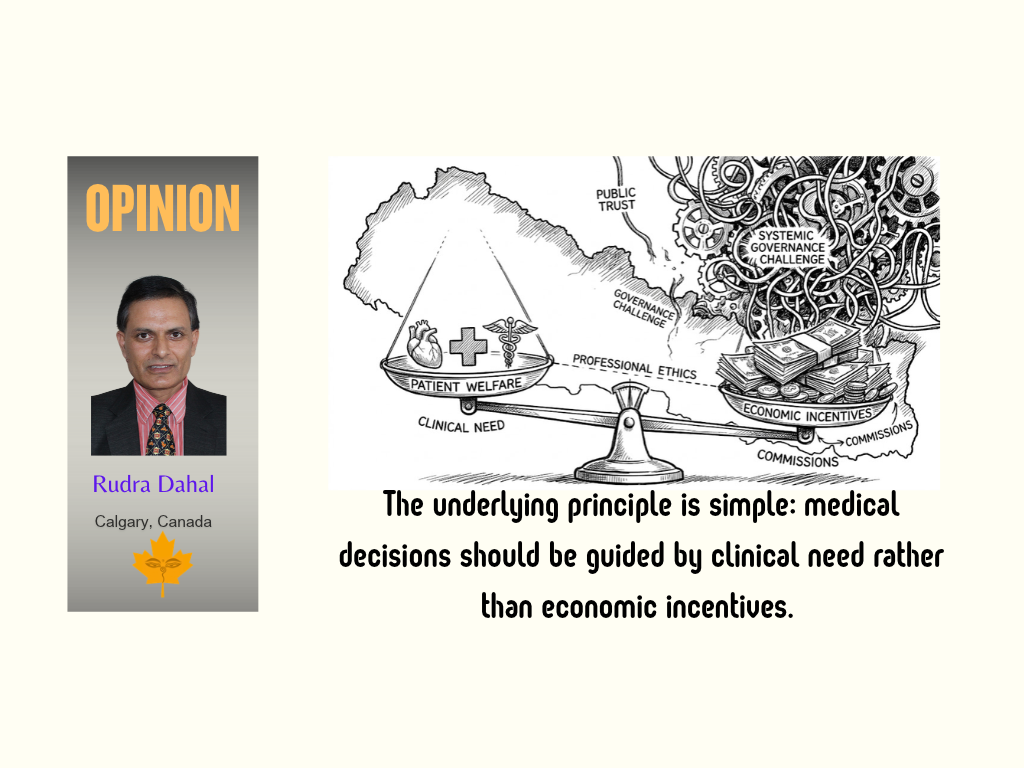
Healthcare is built on trust. When a patient visits a doctor, they assume that every recommendation, whether for medicine, laboratory investigations, imaging studies, or specialist referrals, is made solely in their best interest. Yet across Nepal, a persistent concern continues to surface in public discussions: are some doctors prescribing unnecessary tests in exchange for commissions from diagnostic centers? The question is uncomfortable but important because it touches upon professional ethics, healthcare affordability, and public trust in the medical profession.

Stories about patients being advised to undergo long lists of blood tests, scans, and investigations are common. Many people report being referred to specific laboratories or imaging centers without receiving a clear explanation of why the tests are needed. For families already struggling with rising healthcare costs, such experiences can fuel suspicion. Although these concerns are widespread, it is important to acknowledge that there is currently limited scientific evidence quantifying how common commission-based referrals are in Nepal. Therefore, it would be unfair to accuse the entire medical profession based on anecdotal reports. At the same time, the lack of comprehensive evidence should not lead policymakers or the public to dismiss the concern altogether.
The issue deserves attention because it reflects broader questions about transparency and accountability within Nepal's healthcare system. Patients generally do not possess the medical knowledge necessary to determine whether a particular test is clinically justified. They depend on the expertise and integrity of healthcare professionals. This imbalance of knowledge makes trust essential. If patients begin to suspect that financial incentives influence medical decisions, confidence in the healthcare system itself may be undermined.
A balanced discussion must recognize that not all extensive testing is unnecessary. Modern medicine relies heavily on laboratory investigations and diagnostic imaging. Many illnesses, including cancers, infectious diseases, hormonal disorders, and cardiovascular conditions, cannot be diagnosed accurately through symptoms alone. Doctors often need multiple investigations to confirm a diagnosis, rule out serious conditions, or monitor treatment progress. In many cases, what appears excessive to a patient may be entirely appropriate from a clinical perspective.
Doctors also frequently work under conditions of uncertainty. A patient presenting with fatigue, chest pain, prolonged fever, weight loss, or abdominal discomfort may have dozens of possible diagnoses. Additional testing can help avoid potentially dangerous mistakes. Some physicians may also practice what is commonly called defensive medicine, ordering additional tests because they are concerned about missing rare but serious conditions. Therefore, a high number of investigations should not automatically be interpreted as evidence of unethical behavior.
However, acknowledging these realities does not eliminate the possibility of financial conflicts of interest. The central concern is not the number of tests being ordered but whether medical decisions are influenced by potential financial gain. If doctors receive commissions or incentives from laboratories, diagnostic centers, or healthcare facilities in exchange for referrals, a conflict of interest clearly exists. In such situations, patient welfare may no longer be the sole factor guiding clinical decisions.
International experience demonstrates that this challenge is not unique to Nepal. Many countries have struggled to balance commercial interests with professional ethics in healthcare. Concerns regarding physician self-referral, kickbacks, and diagnostic overuse have led several healthcare systems to adopt laws and ethical regulations designed to limit financial conflicts of interest. Discussions in Canada and the United States have highlighted the risks associated with physicians benefiting financially from the services they recommend. The underlying principle is simple: medical decisions should be guided by clinical need rather than economic incentives.
The potential consequences of unnecessary testing extend well beyond financial costs. For many Nepali households, healthcare expenses are paid out-of-pocket. Additional investigations can create a substantial burden for families with limited resources. Some households may be forced to borrow money, sell assets, or delay other essential healthcare needs. In a country where access to healthcare remains unequal, unnecessary expenditures can deepen existing financial hardships.
There are also clinical implications. Contrary to popular belief, more testing does not always result in better care. Every diagnostic test carries the possibility of false-positive results, findings that suggest a disease or abnormality when no significant health problem actually exists. Such results often trigger further investigations, additional expenses, and considerable anxiety for patients and their families. In some cases, individuals may even undergo unnecessary treatments or procedures based on incidental findings that ultimately prove harmless.
The broader healthcare system can also suffer when diagnostic services are overused. Laboratories, radiology departments, and specialist services have limited capacity. When resources are consumed by tests with limited clinical value, other patients may face longer waiting times or reduced access to necessary services. Ensuring the appropriate use of diagnostic resources is therefore not only an ethical issue but also a matter of healthcare efficiency.
While concerns about commission-based referrals are often framed as a problem involving individual doctors, the issue is more accurately understood as a governance challenge. Healthcare systems should never depend solely on the integrity of individual professionals. Instead, they should include safeguards that minimize the possibility of conflicts of interest and promote transparency. Just as aviation safety relies on robust systems rather than individual pilots alone, healthcare quality depends on effective institutions, oversight mechanisms, and ethical regulations.
For Nepal, strengthening transparency should be a priority. Patients have the right to understand why tests are being ordered and how the results will influence their care. Clear communication can reduce misunderstandings and improve trust. Healthcare providers should be encouraged to explain the purpose, benefits, and limitations of recommended investigations. Greater openness can address many of the concerns that arise when patients feel excluded from decision-making.
The Government of Nepal also has an important role to play. Stronger regulations prohibiting referral commissions and kickbacks would help eliminate ambiguity and discourage unethical practices. Financial relationships between healthcare providers and diagnostic facilities should be subject to appropriate oversight. Developing evidence-based national clinical guidelines could also reduce unnecessary variation in testing practices while supporting physicians in making consistent decisions.
Investment in digital health systems could further strengthen accountability. Electronic health records and billing systems can help identify unusual referral patterns and support data-driven monitoring of healthcare utilization. Rather than relying on rumors or isolated complaints, policymakers could use objective information to examine diagnostic practices and identify areas requiring improvement.
The Nepal Medical Council likewise has a critical responsibility in maintaining professional standards. The Council's ethical framework emphasizes professional integrity and patient welfare. Building upon these principles, the Council could provide more explicit guidance regarding conflicts of interest, referral practices, and financial transparency. Continuing medical education programs should also emphasize ethical decision-making and responsible use of diagnostic investigations. At the same time, mechanisms for confidential reporting of suspected unethical practices should be strengthened to support accountability while ensuring fairness and due process.
Importantly, stronger regulation should not be viewed as an attack on doctors. Most healthcare professionals enter medicine because they wish to help others, and many continue to provide compassionate, ethical care despite challenging working conditions. In fact, effective oversight protects ethical practitioners by ensuring that the conduct of a few individuals does not damage the reputation of the profession as a whole.
In summary, the debate over unnecessary medical testing in Nepal is ultimately about trust. There is currently insufficient evidence to determine how widespread commission-based referrals may be, but the underlying concern cannot be ignored. Experiences from around the world demonstrate that financial conflicts of interest can arise in any healthcare system and require proactive safeguards. Rather than focusing on blame, Nepal should focus on strengthening transparency, accountability, and ethical governance.
The goal is not to reduce testing, nor is it to increase testing. The goal is to ensure that every test is ordered because it is clinically necessary and beneficial for the patient. When medical decisions are guided solely by patient welfare, trust flourishes. Protecting that trust should be a shared responsibility of the government, regulatory bodies, healthcare institutions, and medical professionals. Ultimately, a healthcare system that prioritizes ethics over profit will serve both patients and providers far better in the long run.
Disclaimer: This article represents the author’s personal perspectives and does not reflect the views or positions of any affiliated institution.


 सम्बन्धित खबर



















तपाईंको प्रतिक्रिया