

.jpeg)
Empowering the Next Generation Is Key to the Future of Nepali in Canada
Rudra Dahal
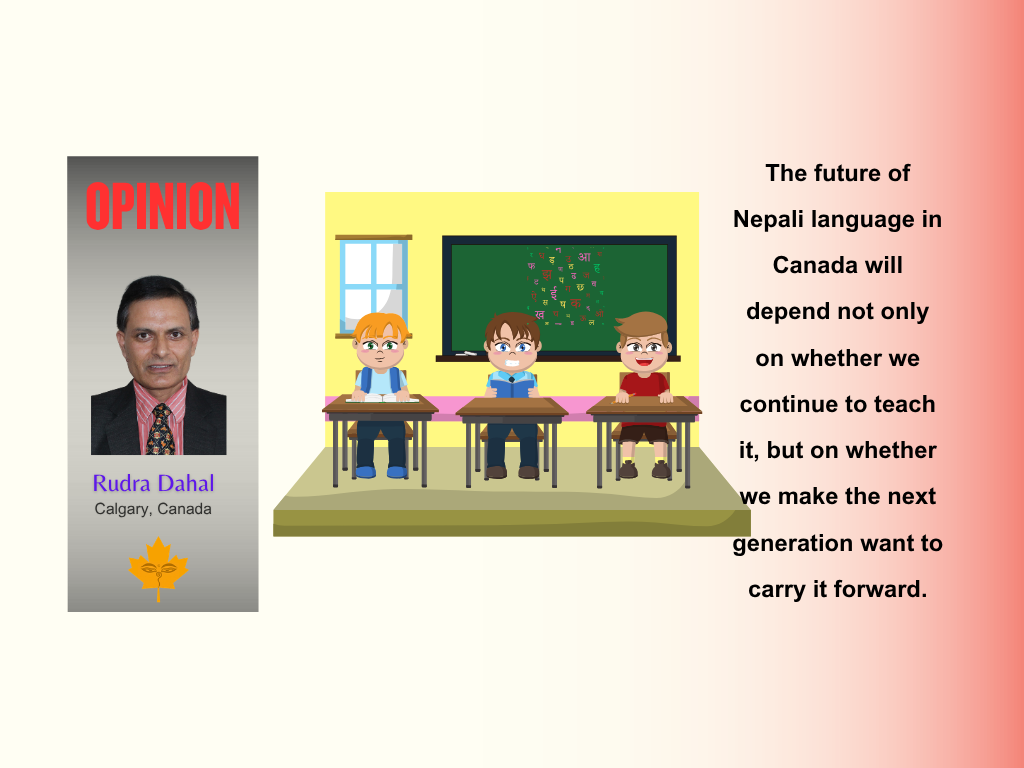
Language is more than a means of communication. For immigrant communities, it carries history, culture, traditions, values, family relationships, and collective identity. For Nepali Canadians, maintaining the Nepali language is therefore not simply about teaching children to speak another language; it is about preserving an important connection between generations and cultures. Across Canada, including Alberta, Nepali community organizations have established language schools, commonly known as Nepali Pathshala, to provide children with opportunities to learn Nepali language, literature, culture, and traditions. These schools have become increasingly important as more Nepali families raise their children in an English-dominant environment.

However, the long-term sustainability and effectiveness of Nepali language schools cannot be taken for granted. Many programs depend heavily on volunteers, community donations, registration fees, and the dedication of a small number of individuals. Teachers often work with limited resources, children have different levels of Nepali proficiency, and schools frequently operate outside the mainstream education system. At the same time, children face competing demands from regular school, sports, music, technology, and social activities. These challenges raise an important question: how can Nepali community language schools evolve from primarily volunteer-driven weekend programs into sustainable, engaging, and effective heritage-language institutions?
The challenges facing Nepali schools are not unique. Community language schools serving Chinese, Korean, Japanese, Arabic, South Asian, and other immigrant communities face similar difficulties in Canada, the United States, Australia, and the United Kingdom. International experience provides valuable lessons for Nepali communities, particularly in relation to teacher development, curriculum, funding, student engagement, and institutional partnerships.
International experience provides valuable lessons for Nepali communities, particularly in relation to teacher development, curriculum, funding, student engagement, and institutional partnerships.
One of the most significant challenges is financial sustainability. Many Nepali language schools depend on tuition fees, donations, fundraising activities, and volunteer contributions. This model may work when a program is small, but it becomes difficult as enrolment increases and expectations rise. Schools need appropriate classrooms, teaching materials, insurance, technology, administrative support, professional development, and curriculum resources. When most of this work depends on volunteers, a small group of community leaders can quickly become overburdened.
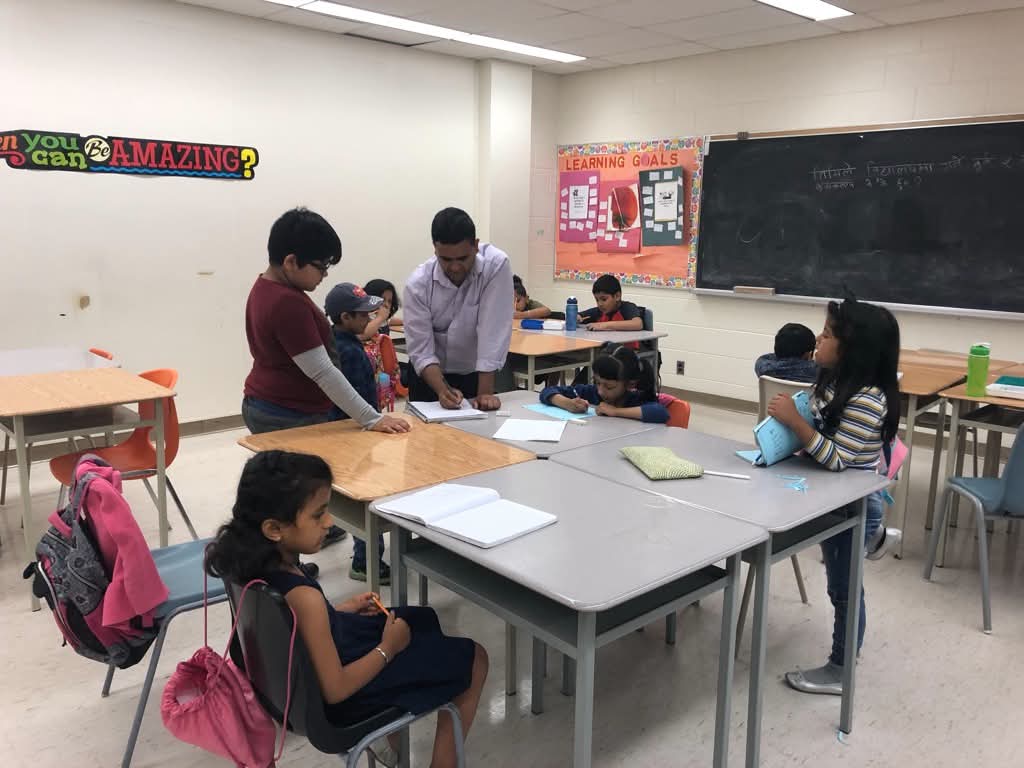
The solution is not to eliminate community involvement but to create a more sustainable financial structure. Nepali organizations should explore municipal, provincial, federal, foundation, and multicultural grants for which they are eligible. Partnerships with public libraries, school boards, universities, settlement organizations, and community foundations could provide facilities, resources, expertise, and funding opportunities. Nepali organizations could also collaborate rather than compete for limited resources. A coordinated approach to funding could make the entire heritage-language sector stronger.
A second major challenge is teacher recruitment and preparation. Speaking Nepali fluently does not automatically make someone an effective Nepali language teacher. Heritage-language learners are different from children who grow up in Nepal. A Canadian-born child may understand Nepali but have difficulty speaking it, while another child may speak Nepali at home but have little ability to read or write Devanagari. Some children may have almost no exposure to Nepali before joining a language school. Teachers therefore need skills in bilingual and heritage-language education, differentiated instruction, child-centered pedagogy, classroom management, and assessment.
International experience strongly supports the importance of teacher preparation. Community language schools in the United States and Australia have reported difficulties related to teacher availability, professional preparation, and access to appropriate teaching resources. Nepali schools could respond by developing regular teacher-training workshops in partnership with Canadian universities, faculties of education, and experienced educators. Mentorship programs could pair experienced teachers with new instructors. Even when teachers remain volunteers, professional development, certificates, recognition, and appropriate compensation where feasible would help improve retention and quality.
Curriculum is another critical issue. Many heritage-language programs use textbooks and teaching materials developed for children in Nepal. These materials can be valuable, but they may not always reflect the experiences of Nepali children growing up in Canada. A child in Calgary or Edmonton experiences a different social, educational, and cultural environment from a child attending school in Kathmandu or Pokhara. A curriculum that relies heavily on memorization, copying, grammar exercises, and examinations may not engage Canadian-born children effectively.
Many heritage-language programs use textbooks and teaching materials developed for children in Nepal. These materials can be valuable, but they may not always reflect the experiences of Nepali children growing up in Canada.
Nepali schools should therefore develop a Canada-specific Nepali heritage-language curriculum. Such a curriculum should preserve Nepali language, literature, history, and culture while connecting learning to children's everyday experiences in Canada. Lessons could incorporate family, friendship, Canadian seasons, food, sports, environment, multiculturalism, festivals, migration, and community life. Nepali folk stories, songs, poetry, theatre, games, and contemporary literature can make language learning more meaningful.
The curriculum should also recognize different levels of proficiency. Students should not be grouped only according to age. Their speaking, listening, reading, and writing abilities should also be considered. A flexible, level-based curriculum would allow children to progress according to their abilities rather than becoming frustrated by material that is either too easy or too difficult.
Perhaps the greatest challenge is maintaining children's motivation. Children may initially attend Nepali school because their parents want them to, but parental pressure alone is unlikely to sustain participation for many years. As children become older, they have increasingly demanding schedules and many competing interests.
International research provides an important warning. A recent Canadian study of a Mandarin community language school found that although parents and children generally valued the program, students identified concerns including homework, long classes, difficulty with literacy, and reduced opportunities for play. This experience offers an important lesson for Nepali schools: children need to enjoy learning the language.
Nepali language education therefore needs to become more interactive, creative, and child-centered. Instead of focusing primarily on textbooks and examinations, schools can use storytelling, theatre, music, games, debates, poetry, art, digital media, and project-based learning. Older students could produce Nepali podcasts, videos, or online stories for younger children. Students could interview grandparents, document family histories, or create projects about Nepali culture in Canada. When children use Nepali to create something meaningful, language becomes an experience rather than simply another subject.
Instead of focusing primarily on textbooks and examinations, schools can use storytelling, theatre, music, games, debates, poetry, art, digital media, and project-based learning. Older students could produce Nepali podcasts, videos, or online stories for younger children.
Another challenge is language shift toward English. English is the dominant language of education, employment, public life, media, and peer interaction in Canada. Children therefore have strong incentives to use English. This should not be viewed as a failure of parents or children. Language shift is a common experience among immigrant communities around the world.
The objective should not be to create competition between Nepali and English. Instead, Nepali schools and families should promote additive bilingualism—strong English alongside continued development of Nepali. Parents can support this by creating opportunities for Nepali at home through conversations, storytelling, reading, family meals, and communication with grandparents and relatives. Children should also understand that bilingualism is an asset that connects them to family, culture, international communities, and potentially future educational and professional opportunities.
Parents are essential partners, but their role should be realistic. Parents should not be expected to become Nepali teachers. Instead, schools can provide practical guidance on how families can support language learning at home. Parent orientation sessions could explain the importance of heritage-language maintenance and provide simple strategies for incorporating Nepali into everyday family life. Children are more likely to value the language when they see that their parents, grandparents, teachers, and community leaders value it too.
A further challenge that deserves attention is organizational fragmentation. Nepali communities across Canada include numerous organizations, associations, cultural groups, and language programs. Diversity is valuable, but when organizations operate completely independently, resources can be duplicated and opportunities for collaboration can be missed. Different schools may develop their own curriculum, teacher-training approaches, registration systems, and assessment practices without sharing lessons with one another.
A provincial or national Nepali Heritage Language Education Network could help address this problem. Such a network would not need to control individual schools. Instead, it could provide a platform for sharing curriculum materials, teacher-training opportunities, funding information, assessment tools, and successful practices. It could also advocate collectively greater recognition of heritage-language education.
International experience provides several useful models. In Australia, community language schools have become an established part of the country's multicultural education environment. The Australian experience demonstrates that community ownership can coexist with government and institutional support. The United States has a long history of community-based heritage-language schools and illustrates both the value of community leadership and the difficulties created by limited resources and teacher preparation. The United Kingdom similarly demonstrates the importance of complementary schools while highlighting the need for stronger recognition within the wider education system.
Canada can learn from these experiences while developing a model appropriate to its own multicultural context. Nepali language schools should not necessarily become part of the public school system, nor should governments take over community programs. Instead, a partnership model may be most appropriate. Communities can retain ownership of their language and cultural programs while universities, libraries, school boards, settlement agencies, and governments provide expertise, facilities, professional development, research support, and where appropriate, financial assistance.
Communities can retain ownership of their language and cultural programs while universities, libraries, school boards, settlement agencies, and governments provide expertise, facilities, professional development, research support, and where appropriate, financial assistance.
Universities have a particularly important role to play. Faculties of education, linguistics, and other relevant disciplines could work with Nepali community organizations to evaluate existing programs, develop curricula, train teachers, and study student outcomes. Such partnerships would help move Nepali heritage-language education from anecdotal practice toward evidence-informed practice.
The future of Nepali language schools ultimately depends on whether they can adapt to the realities of the next generation. Children growing up in Canada are not simply "little Nepalis living abroad." They are Canadian children with multicultural identities and experiences. Their language education must recognize this reality. The purpose of a Nepali pathshala should therefore not be to recreate a classroom from Nepal in Canada. It should be to create a learning environment where Nepali language and culture are connected meaningfully to children's Canadian lives.
This requires a shift in thinking. The goal should not simply be to preserve the language of the past but to make Nepali relevant to the future. A successful Nepali pathshala should be a place where children can speak with their grandparents, read Nepali stories, sing Nepali songs, understand their cultural history, explore their identity, make friends, and confidently express themselves as bilingual or multilingual Canadians.
The responsibility for achieving this does not belong to schools alone. It is a shared responsibility of parents, teachers, community organizations, cultural leaders, researchers, educational institutions, and governments. Each has a different role to play. Parents can create supportive language environments at home. Teachers can make classrooms engaging and inclusive. Community organizations can collaborate and provide leadership. Universities can contribute research and professional expertise. Governments and educational institutions can recognize the broader social value of heritage-language education.
Nepali community language schools have already accomplished something significant: they have created spaces where the younger generation can encounter the language and culture of their parents and grandparents. The next step is to strengthen these institutions so that they are sustainable, professionally supported, evidence-informed, and attractive to children.
Ultimately, preserving Nepali in Canada is not simply about protecting the past. It is about giving the next generation another language through which they can understand their families, connect with their heritage, and participate confidently in Canada's multicultural society. If Nepali community language schools can successfully combine cultural authenticity with modern pedagogy, community leadership with institutional partnerships, and language preservation with children's interests, they can become powerful institutions of intergenerational connection and community empowerment. The future of Nepali language in Canada will depend not only on whether we continue to teach it, but on whether we make the next generation want to carry it forward.
-MEd, MHSM, MSc
Disclaimer: This article represents the author’s personal perspective and does not reflect the views or positions of any affiliated institution.
.gif)

 सम्बन्धित खबर
.png)
.png)






.png)









तपाईंको प्रतिक्रिया