


Nepal, Canada, and the Limits of Industrial Patriotism
Dr. Rajendra Panthee
A confession before the argument

I hesitated before publishing my blog post on August 17 about reopening Nepal’s closed industries. At the time, many Rastriya Swatantra Party (RSP) supporters were saying that what the party was doing was great. I worried that any caution about reopening factories would be taken as opposition to Nepal, opposition to the RSP, or disrespect for people who wanted jobs and national self-reliance.
I am hesitant again now. I do not claim to have a complete understanding of industrial policy, public finance, or the future of manufacturing. But I see a connection between the debate in Nepal and the debate now taking place in Canada. In both countries, people are asking whether government ownership can save industries and protect workers.
In Nepal, the question concerns closed public enterprises and the promise to bring them back to life. In Canada, it has arisen after major layoffs in Hamilton’s steel industry and after Stellantis decided to sell its idled Brampton assembly plant. The circumstances are different, but the emotional question is similar. Should the government take ownership, spend public money, and keep factories running even when the market has turned against them?
Hamilton and the call for public ownership
The Hamilton discussion began after Stelco, owned by the American company Cleveland-Cliffs, announced plans to lay off up to 500 workers at its Hamilton and Nanticoke operations. The company cited American tariffs, weak demand for Canadian steel, and competition from imported steel. By early November, 175 workers had already been laid off in Hamilton.
The layoffs did not happen in isolation. Algoma Steel in Sault Ste. Marie had earlier issued layoff notices to about 1,000 workers, close to one third of its workforce. Stelco’s decision therefore became part of a wider anxiety about Canadian manufacturing, trade with the United States, and the loss of well-paid industrial jobs.
Federal NDP Leader Avi Lewis and Ontario NDP Leader Marit Stiles called for the federal government to nationalize Stelco. The president of United Steelworkers Local 1005, Ron Wells, also said his local had long supported public ownership of the steelmaker. Their argument was that court action could take too long and that public ownership might protect jobs and Canada’s steelmaking capacity.
These calls are understandable. Steel is not an ordinary consumer product. It is important for construction, defence, infrastructure, energy, and national security. A country that loses its steel capacity may find it difficult to rebuild quickly during a crisis.
But sympathy for workers should not prevent us from asking hard questions. If Stelco is unprofitable because of weak demand, high costs, tariffs, or global competition, would public ownership solve those problems? A government can buy a steel company. It cannot simply order the world to buy Canadian steel at a profitable price.
Canada is not Nepal, but the temptation is similar
Canada and Nepal are very different countries. Canada has a large industrial economy, advanced infrastructure, strong institutions, and access to global capital. Nepal has a smaller economy, limited capital, weaker industrial capacity, and a long history of public enterprises affected by political interference.
Yet the political temptation is similar. When factories close, people understandably blame globalization, foreign owners, tariffs, previous governments, or privatization. The easiest answer is to say that the state should take over the factory, reopen it, and protect jobs.
In Nepal, the RSP has presented reopening closed industries as a sign of national renewal. Supporters see it as a rejection of governments that allowed public enterprises to decline. In Canada, some people see nationalization as a way to stop American owners from cutting Canadian jobs and moving production south.
Both arguments contain a real concern. Nepal should not become entirely dependent on imports for goods it could reasonably produce. Canada should not casually surrender industrial capacity that may matter in a future crisis. But concern is not the same as a plan.
What ownership can change
Government ownership can make sense in certain situations. It may be justified for essential medicines, food security, emergency supplies, public utilities, defence-related production, and strategic infrastructure. In these areas, profit is not the only measure of success. The public may need reliable supply, national resilience, or services that private companies will not provide.
Public ownership can also help when a private owner has broken commitments to workers or communities. Canada has a reason to examine whether Cleveland-Cliffs violated undertakings made when it acquired Stelco. Industry Minister Mélanie Joly has said the government may pursue penalties, court orders, or even a forced sale of Canadian assets.
That is different from saying the government should permanently operate every struggling factory. Enforcing a contract is not the same as owning a business. Protecting workers during a transition is not the same as guaranteeing that an uncompetitive production line will continue forever.
What ownership cannot change
A factory is more than a building. It needs customers, competitive costs, modern technology, reliable suppliers, skilled workers, competent managers, and a product that people want to buy. If those conditions are missing, public ownership may only delay the same outcome at a higher cost to taxpayers.
Nepal’s public enterprises show this danger. The Nepal Rastra Bank reported that 28 public enterprises made profits while 15 recorded losses in the latest review year. The net profit of profitable enterprises fell by 11.5 percent, while the net loss of loss-making enterprises increased by 8.65 percent. These numbers do not prove that every public enterprise should be sold. They do show that public ownership does not automatically produce efficiency, profitability, or good management.
Nepal has also not privatized a state-owned enterprise since 2008. Reform has been slowed by union resistance, procedural delays, and a lack of political will. Meanwhile, some public enterprises continue to operate with weak governance, political appointments, and unclear commercial goals.
If Nepal reopens factories by filling them with party supporters, relatives, and political loyalists, it will not create industrial revival. It will recreate the old system under a new political label.
Stellantis and the limits of subsidies
The Stellantis case adds another lesson. Canada did not own Stellantis. It offered public support to encourage the company to invest in Canadian production. In 2022, Ottawa committed up to CAD 529 million to help retool Brampton and Windsor for electric-vehicle production. The agreement was intended to keep the Brampton plant operating until 2035.
Stellantis later moved planned Jeep Compass production to the United States amid tariffs and changing business conditions. It then agreed to sell the idled Brampton plant to Roshel, a Canadian defence company. Prime Minister Mark Carney called the decision unacceptable and a betrayal of workers and Canada.
The government is right to demand accountability. Public money should not become a gift to a multinational company that can change its plans when tariffs or markets shift. But even if Stellantis repays public funds, that will not automatically restore the jobs, suppliers, and automotive future that workers expected.
This is the hard truth about industrial policy. Subsidies can encourage investment, but they cannot guarantee that a company will remain committed. Public ownership can preserve capacity, but it cannot guarantee that the capacity will be competitive. Tariffs can protect domestic producers, but they can also raise costs for other industries and consumers.
A better test
Before a government takes over a factory, reopens a closed enterprise, or gives a company public money, it should answer a few basic questions.
Why did the enterprise fail? Who will buy its product? Can it compete on cost, quality, and technology? How much public money will be needed, and for how long? Who will manage it? Will hiring be based on skill or political connection? What happens if it continues to lose money? What protections will workers receive if it cannot survive?
These questions are not anti-worker. They are pro-worker in the long run. Workers need more than a reopening ceremony. They need stable employment, fair wages, safe workplaces, and industries that can survive without permanent public rescue.
The choice is not simple
Nepal does not have to choose between reopening every closed factory and selling every public enterprise. Canada does not have to choose between allowing foreign owners to cut jobs freely and nationalizing every struggling company.
Some enterprises may be strategically important and should remain public. Some may become viable after restructuring, new investment, or a public-private partnership. Some may be beyond repair and should be closed in an orderly and humane way. Some private companies may need conditions attached to public support, including repayment obligations if they fail to deliver promised jobs or production.
The real issue is not whether government ownership is good or bad in the abstract. The real issue is whether it serves a clear public purpose, is managed competently, and is accountable to taxpayers.
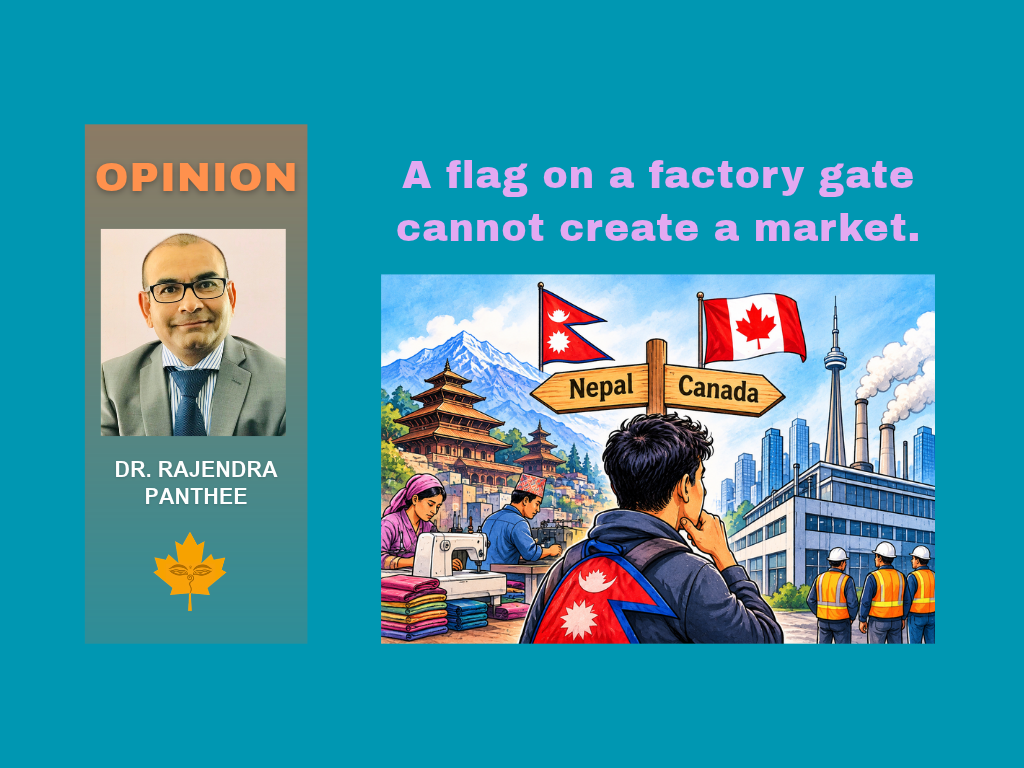
Patriotism does not mean reopening an old factory regardless of cost. Patriotism means using public money carefully, protecting workers honestly, and refusing to confuse political symbolism with economic strategy. A flag on a factory gate cannot create a market. A government announcement cannot replace productivity. And public ownership cannot solve a problem if the underlying business model has already failed.


 सम्बन्धित खबर














तपाईंको प्रतिक्रिया