

.jpeg)
Dual Citizenship Is Not a Privilege; It Is Nepal's Opportunity!
Rudra Dahal
.gif)
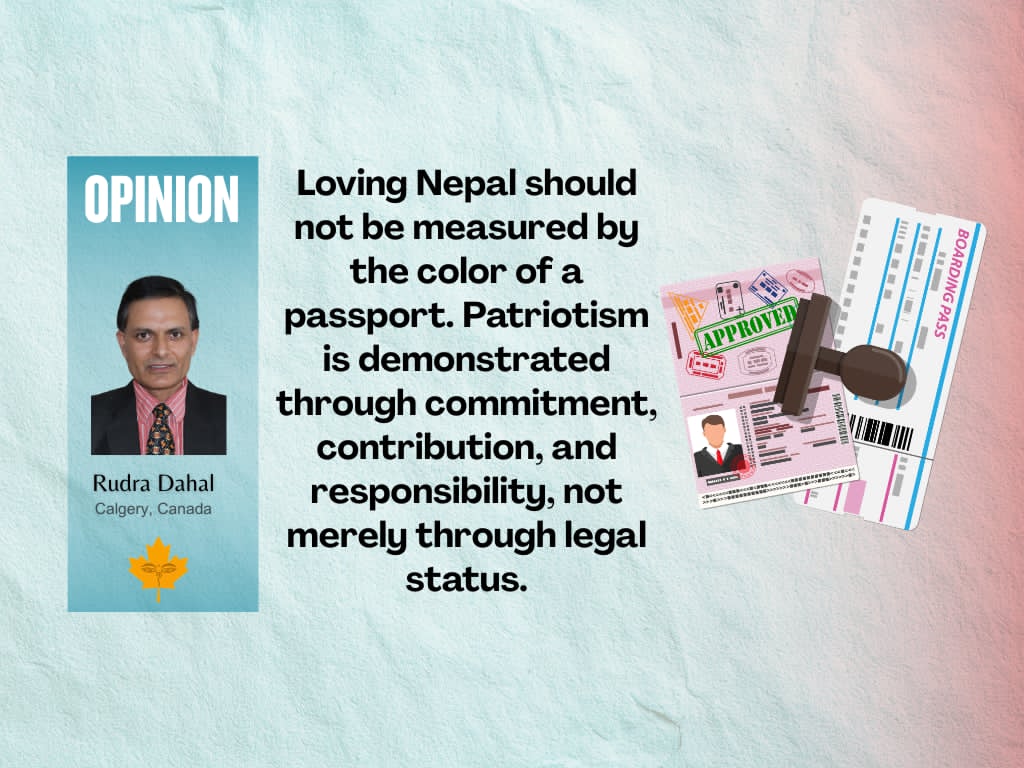
Every time I hear someone say, "If you became a citizen of another country, you are no longer Nepali," I find myself asking a simple question: Can a passport erase a person's identity? I do not think it can.

Over the years, I have met hundreds of Nepalis living in Canada, Australia, the United States, the United Kingdom, across Europe, Japan, and many other countries. They come from diverse walks of life—medical doctors, professors, nurses, researchers, entrepreneurs, taxi drivers, skilled professionals, and countless others working tirelessly to build better futures for their families. Despite living thousands of miles away from home, they celebrate Dashain and Tihar with remarkable enthusiasm, teach their children the Nepali language, culture, raise funds whenever Nepal faces floods, earthquakes, or other disasters, and devote countless hours to promoting Nepal wherever they live. Yet, in legal terms, many of them are no longer recognized as Nepali citizens because they have acquired the citizenship of another country. I believe this contradiction deserves serious national reflection.
In my opinion, the debate over dual citizenship is not really about passports; it is about how we define belonging in an increasingly mobile world.
In my opinion, the debate over dual citizenship is not really about passports; it is about how we define belonging in an increasingly mobile world. I believe that most Nepalis who acquire foreign citizenship do so not because they wish to leave Nepal behind, but because they seek the legal rights, opportunities, and security necessary to build stable lives in their adopted countries. Citizenship often opens doors that permanent residency cannot, including education, equal employment opportunities, voting rights, easier international travel, stronger legal protections, and greater certainty for future generations. Seen from this perspective, acquiring another citizenship is less an emotional choice than a practical adaptation to the realities of migration.

What surprises me most is that we often celebrate the achievements of Nepalis abroad while simultaneously questioning their commitment to Nepal. Whenever a Nepali becomes a university professor in Canada, a scientist in the United States, a successful entrepreneur in Australia, or a physician in the United Kingdom, Nepal proudly claims them as "our own." Their achievements become a matter of national pride. Yet when those same individuals request dual citizenship, some suddenly accuse them of divided loyalty. I find this contradiction difficult to understand.
Some people argue that if someone chooses another citizenship, they should also accept losing their legal connection to Nepal.
Some people argue that if someone chooses another citizenship, they should also accept losing their legal connection to Nepal. I understand where this concern comes from. Citizenship carries responsibilities as well as rights. Every sovereign nation has the responsibility to protect its constitutional integrity, national security, and political system. Questions about voting rights, eligibility for constitutional offices, taxation, military obligations, and diplomatic protection are legitimate. They deserve thoughtful discussion rather than emotional reactions.
However, I do not believe these concerns justify rejecting the entire idea of dual citizenship. Many countries have already demonstrated that national sovereignty and dual citizenship can coexist. Canada and Australia recognize dual citizenship because they understand that modern identities are often multilayered. The United Kingdom follows a similar approach. Even India, which historically opposed dual citizenship, eventually created the Overseas Citizenship of India (OCI) scheme. Although OCI does not grant voting rights or eligibility for constitutional office, it allows millions of overseas Indians to maintain meaningful legal and economic ties with their country of origin. India did not see its diaspora as a threat; it saw them as an opportunity.
This is where I think Nepal should pause and ask itself an important question. Are we debating dual citizenship because we genuinely fear risks to national sovereignty, or because we continue to think about citizenship through an outdated lens? Migration has transformed the world. Today, millions of people contribute to more than one country. They pay taxes where they live, while continuing to support parents, invest in businesses, fund scholarships, promote tourism, and preserve cultural traditions in the countries they left behind. Globalization has not weakened national identity; it has simply made identity more complex.
I also think we sometimes underestimate the contribution of the Nepali diaspora. Public discussions often reduce overseas Nepalis to one number—remittances.
I also think we sometimes underestimate the contribution of the Nepali diaspora. Public discussions often reduce overseas Nepalis to one number—remittances. Remittances are undeniably important, but they represent only part of the story. Overseas Nepalis contribute knowledge, innovation, research collaborations, technology, international networks, philanthropy, and entrepreneurship. They create bridges between Nepal and the rest of the world. Many introduce Nepal to international investors, universities, and organizations. These contributions cannot be measured in financial statistics alone.
That said, I do not believe dual citizenship is a magic solution. If Nepal expects billions in investment simply by changing citizenship laws, it will probably be disappointed. Investors seek political stability, transparent institutions, efficient bureaucracy, predictable policies, and the rule of law. Without these foundations, dual citizenship alone will not transform Nepal's economy. This is why I believe citizenship reform should be viewed as one part of a broader strategy for engaging the global Nepali community rather than as an economic shortcut.
Another aspect of this debate concerns me deeply. What message are we sending to the next generation? Thousands of children born in Canada, Australia, the United States, and Europe proudly call themselves Nepali. Their parents teach them the language, celebrate Nepali festivals, and encourage them to visit Nepal. But if Nepal continues to tell these young people that they cannot maintain a meaningful legal relationship with the country of their ancestors, future generations may gradually lose that connection. Nations do not preserve themselves only through borders; they preserve themselves through relationships.
Nepal does not necessarily need to copy Canada's model or India's model. Every country's history and constitution are different.
In my view, Nepal does not necessarily need to copy Canada's model or India's model. Every country's history and constitution are different. Nepal should design a system that reflects its own realities. It may choose to allow dual citizenship with certain limitations. It may decide to expand the rights of Non-Resident Nepalis while reserving voting rights or constitutional offices for citizens residing in Nepal. There are many possible models. What matters is the willingness to have an honest, evidence-based conversation rather than reducing the issue to accusations of patriotism or disloyalty.
I also believe the tone of this debate needs to change. Too often, people who advocate for dual citizenship are portrayed as demanding special privileges. I do not see it that way. Most are asking for something much simpler—the opportunity to remain legally connected to the country they still call home. Loving Nepal should not be measured by the color of a passport. Patriotism is demonstrated through commitment, contribution, and responsibility, not merely through legal status.
Ultimately, the question before Nepal is larger than dual citizenship itself. It is about how we define our nation in an increasingly interconnected world. Do we see our millions of overseas Nepalis as people who left, or as people who expanded Nepal's presence beyond its borders? I believe the answer to that question will shape Nepal's relationship with its diaspora for generations to come.
In my opinion, Nepal should stop asking whether the diaspora deserves dual citizenship and begin asking how the nation can build a stronger partnership with those who have never stopped carrying Nepal in their hearts.
Disclaimer: This article represents the author’s personal perspective and does not reflect the views or positions of any affiliated institution.
.gif)

 सम्बन्धित खबर










.png)
.png)



तपाईंको प्रतिक्रिया