

.jpeg)
The Art of Leading the Canadian Nepali Community
Naresh Gyawali
.gif)
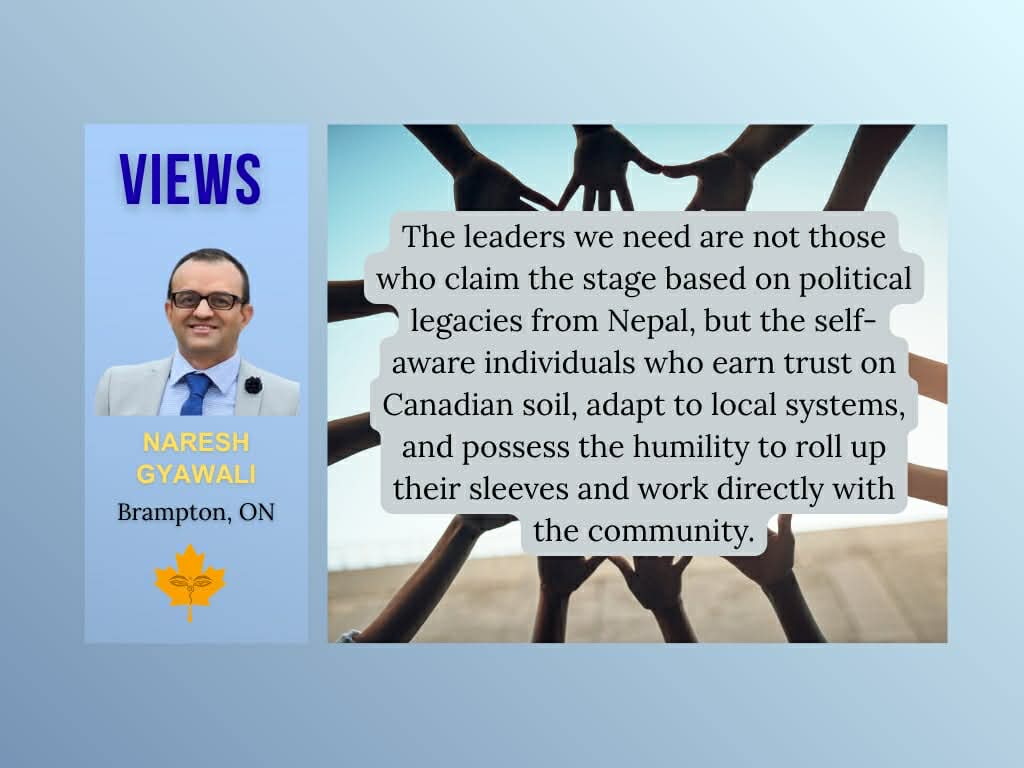
Many community leaders struggle to leave a lasting impact simply because they lack an objective understanding of their own skills, knowledge, and leadership capabilities. True leadership rarely cares about the size of an office, the number of photos on a social media feed, or the grandeur of a self-proclaimed title. In the context of the Nepali diaspora in Canada, therefore, effective leadership across organizations like NRNA, NCNC, NCHC, NCCS, and other location community organizations requires a profound shift in perspective. The leaders we need are not those who claim the stage based on political legacies from Nepal, but the self-aware individuals who earn trust on Canadian soil, adapt to local systems, and possess the humility to roll up their sleeves and work directly with the community.
If you have spent any time trying to organize, volunteer, or bring people together within our community, you have likely felt the deep frustration of watching promising initiatives stall. A community leader in Canada must be a civic architect. We look at a community navigating the challenges of settlement, professional integration, and cultural preservation, and we ask: How do we build something better together?

To get there, you must first have an honest, courageous conversation about where you are tripping over you own feet.
The Root Causes: Why Are Our Leaders Struggling?
It is no secret that there is a widening gap between what our community needs and what current leadership is delivering. This struggle doesn’t usually stem from a lack of care, but from deep-seated patterns imported from back home that simply do not work in a Canadian civic context. Let’s look the five major contributing causes among many for this struggle.
1. The Echoes of Back-Home Politics
The most prominent hurdle is the temptation to treat Canadian community organizations as miniature battlegrounds for Nepali political parties. When leadership positions are handed out based on party loyalty, past political affiliations, or factional balancing rather than actual competence, the organization loses its purpose. It fragments a relatively small diaspora along lines that mean nothing to our life in Canada.
2. The Qualifications & Skills Mismatch
Back home, a "leader" is often defined by loud rhetoric, patronage networks, and the ability to command a crowd from a stage. In Canada, leadership requires an entirely different technical toolkit. Many self-proclaimed leaders struggle with the practical mechanics of running a modern, sustainable organization, such as, leading from front inspiring and influencing, project management and milestones, data-driven planning rather than emotional, ad-hoc decision-making, and transparent, professional financial tracking and budgeting.
3. The Grand Illusion: Self-Perception vs. Community Reality
There is a massive psychological blind spot paralyzing many diaspora organizations: the profound gap between a leader's self-perception and the community’s perception of them. When someone's entire definition of authority is rooted in an outdated model, they genuinely believe that just stepping up to a microphone, showing passion, and commanding the stage makes them a leader. They don't realize that the audience, especially the younger generation and professional newcomers, isn't looking at them with admiration; they are looking at them with second hand embarrassment.
4. The Communication Barrier and Public Exposure
Nowhere is this gap between ego and ability more painfully obvious than during public events. While there is absolutely no shame in migrating to a new country and navigating a second language, effective leadership requires a deep sense of self-awareness and preparation.
Too often, community figures attempt to wing ad-hoc, emotionally driven speeches in front of native English speakers, Canadian municipal officials, or corporate sponsors without proper structure or correct grammar. When a self-proclaimed leader struggles to put together a cohesive sentence in public, it does a massive disservice to everyone. It doesn't just expose their personal limitations; it unfortunately risks misrepresenting the entire Canadian Nepali community as unprofessional or uneducated to outside organizations.
5. Gatekeeping and the "Ego Over Impact" Dilemma
There is a massive influx of highly educated, professionally successful young Nepalis, international students, and corporate professionals landing in Canada. Yet, established leaders often gatekeep organizations out of fear of losing their status or being exposed for their lack of qualifications. When ego is prioritized over impact, the community loses its brightest minds and its future stability.
How do you grow the leader within yourself to better serve the community?
If you are a leader or aspiring to be one who wants to build real, lasting credibility in Canada, the path forward requires a deliberate evolution of your skillset and mindset. In my opinion the following roadmap to growth can help aspiring leaders in our community adapt, improve, and succeed:
1. Treat Public Service as a Profession, not a Status
Step away from the microphone and look at the ground. Your effectiveness is measured exclusively by your tangible impact on Canadian soil: How many newcomers did we help find safe housing? How many international students did we mentor into professional careers? How many seniors did we connect to local services? How many struggling individuals did we inspire, influence, encourage, and motivate to work hard? Shift your focus from seeking titles to delivering measurable, quiet execution, and inspiring people.
2. Radical Self-Awareness in Communication
An authentic leader understands that communication is about outcomes, not personal vanity. If public speaking in English is a weak point, a real leader doesn't force it just to get stage time. They write out their notes, review them, and practice relentlessly before stepping up. Outside of our community, Canadian officials don't care about loud, poetic rhetoric; they care about data, structured arguments, clear timelines, and professional execution. A well-written, single-page brief or a tightly rehearsed, two-minute introduction is infinitely more powerful than a fifteen-minute rambling speech.
3. The Power of Strategic Delegation
True leadership is about leveraging the strengths of the collective. If you need to pitch a project to a city council or negotiate with a corporate sponsor, a strong leader steps back and says: "My strength is community mobilization, but your strength is professional English communication. I want you to deliver this presentation on behalf of our team." Sharing the spotlight isn't a sign of weakness; it is the ultimate sign of competency.
4. Pass the Torch: Share Power to Build Sustainability
True leadership is about building a sustainable pipeline of future leaders, not maintaining a monopoly on influence. Actively recruit young professionals, corporate experts, and women into core decision-making roles. If your own technical writing or systemic knowledge is a barrier, empower a younger, qualified community member to lead the project while you provide strategic guidance.
How do you navigate the Canadian Corridors of Power as a leader?
An effective community leader doesn't just host internal community cultural events; they understand how to pull the levers of the Canadian political and social systems. Navigating the three distinct tiers of government requires a tailored, professional approach:
Municipal Government (The Ground Floor)
This is where the rubber meets the road. Local government dictates daily quality of life: community centers, parks, local bylaws, and neighborhood grants. The Strategy here should be to build genuine, long-term relationships with city councillors, attend council meetings, and submit highly polished proposals for local space allocation and municipal funding.
Provincial Government (The Infrastructure Hub)
This tier handles the heavy machinery of society: education systems, healthcare delivery, settlement services, and major cultural grants. The strategy here should be to identify the exact ministries relevant to community integration (e.g., ministries dealing with immigration, labor, or culture), Members of Provincial Parliament (MPP) from our area, keep a sharp eye out for provincial grant cycles, and learn the art of professional policy advocacy.
Federal Government (The Big Picture)
The highest tier deals with macro-issues: immigration policies, citizenship, national infrastructure, and massive heritage and cultural funding. The strategy for this highest tire should be to build a direct, professional line of communication with your local Member of Parliament (MP), and learn how to navigate the meticulous, highly competitive world of federal grant applications.
Further, to keep leadership grounded, organized, and sustainable, you can adapt the four pillars of modern leadership as a framework:
|
Pillar
|
Core Focus
|
Actionable Objective
|
|---|---|---|
|
Serve
|
Humility & Integrity
|
Prioritize the community's actual needs; housing, jobs, integration, above personal ambition or political vanity.
|
|
Connect
|
Trust & Alliance
|
Build unbreakable bridges between the Nepali community and wider Canadian society, governments, and businesses.
|
|
Empower
|
Sustainability
|
Mentor youths, international students, and women, actively training the next generation of professional leaders.
|
|
Transform
|
Measurable Progress
|
Drive long-term improvements through data-driven planning, transparent budgeting, and real, visible outcomes.
|
As we look to the future of our community, guarding our leadership means consciously choosing to avoid these seven common traps:
-
Importing Political Feuds: Letting political alignments from Nepal dictate organizational decisions or create divisions in Canada.
-
Chasing the Spotlight: Seeking personal recognition, stage time, or photos with politicians above actual community benefit.
-
Communication Isolation: Speaking only to our own community in our own language, thereby failing to advocate effectively to Canadian institutions.
-
Gatekeeping and Ego: Refusing to involve highly educated, skilled, or younger community members out of fear of losing your "leader" status.
-
Financial Opacity: Managing community or association funds without strict, transparent, and professional accounting practices.
-
Fragile Egos: Becoming defensive, hostile, or personal when receiving constructive feedback from community members.
-
Grand Promises, Zero Delivery: Making loud, emotional speeches on stage but failing to follow through with the actual, quiet work required to execute projects.
When everything else is stripped away, the ultimate measure of your leadership boils down to a simple, powerful benchmark of respect: The Golden Rule: A truly respected community leader strives to be trusted by their community members, respected by Canadian government agencies, welcomed by other diverse communities, and renowned for building durable bridges rather than digging bitter divisions.
When you consistently anchor your actions in integrity, commit to developing real professional skills, drop the home-country political baggage, and deliver tangible results, you transcend being just a voice. You become an invaluable, undeniable asset to the Canadian Nepali community and a deeply respected partner in the wider Canadian mosaic.
-Brampton, Canada
.gif)

 सम्बन्धित खबर






.png)

.png)
.png)
.png)





तपाईंको प्रतिक्रिया