

.jpeg)
RSP, Masterni, and the Politics of Performance
Dr. Rajendra Panthee
.gif)
Nepal has reached a stage where almost everything can become content, and almost any controversy can become free publicity. That may be the most efficient business model we have developed. A song appears, people object, more people object, professors object, teacher organizations object, social advocates object, and suddenly the song is no longer just a song. It has become a national event. Priyanka Karki says it is only entertainment. Perhaps. But in today’s Nepal, entertainment and provocation often arrive wearing the same clothes.

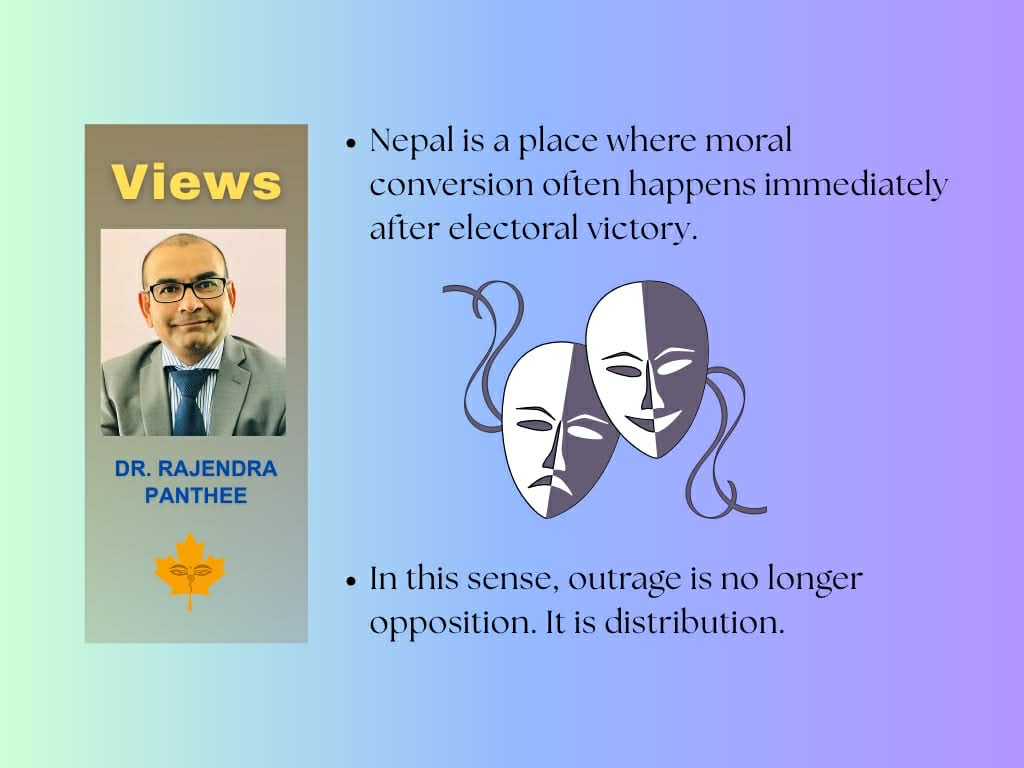
This is not a new trick. In fact, it is one of the oldest tricks in the modern publicity handbook. Say something a little too suggestive, a little too loud, a little too clever for its own good, and then wait for the outrage to do the marketing. If people remain silent, the song sinks. If they protest, the song rises. If they condemn it with moral certainty, the algorithm smiles. Everyone becomes part of the campaign, whether they intended to help or not. In this sense, outrage is no longer opposition. It is distribution.
When a song built on double meaning becomes the center of public debate, it tells us something about the culture around it.
That is why the reaction to Masterni is interesting. People are not merely saying that they dislike the song. They are reacting as though it represents something larger and more corrosive. They see a cheapness in the style, a disrespect in the language, and a familiar willingness to use controversy as a shortcut to attention. When a song built on double meaning becomes the center of public debate, it tells us something about the culture around it. It tells us that shock value still sells, but it also tells us that many people are tired of being asked to clap for it.
The backlash is not just about taste. It is about dignity. Teacher organizations, professors, and social advocates are objecting because they feel the song crosses a line that should not need much explaining. That itself is revealing. A society does not debate such things this intensely unless it senses that its public language is getting sloppier, louder, and more careless. What was once considered crass can now be packaged as confidence. What was once seen as vulgar can now be defended as fun. What was once embarrassing can now be monetized.
And this is where the song begins to resemble politics.
Nepali politics has long perfected the art of saying one thing, doing another, and calling the whole thing democratic. Leaders rise by declaring that they are different from the old class. They promise integrity, service, simplicity, and accountability. Then they learn what every successful politician eventually learns. Power is more enjoyable than principle, and principles are easier to defend from the opposition bench. Once inside the system, the reformer discovers the perks of the system. The convoy grows. The sensitivity shrinks. The criticism is dismissed as jealousy. The public is asked to admire confidence that looks suspiciously like entitlement.
That is why the RSP story and the Masterni story are not as far apart as they first seem.
That is why the RSP story and the Masterni story are not as far apart as they first seem. In both cases, performance is doing a great deal of work. In both cases, there is a strong dependence on image. In both cases, the public is expected to accept provocation as authenticity. And in both cases, the response from society reveals that people are not as passive as the performers may have hoped.
RSP came to power promising a cleaner politics. It presented itself as the antidote to the old parties and their habits. But recent speeches in Parliament have exposed a different picture. Gyanendra Shahi has publicly pointed to the contradictions. Those who once opposed Parliament are now members of Parliament. Those who once said they would not take public money now take it. Those who once declared they would not need security now move with security like minor royals. The satire almost writes itself. Nepal is a place where moral conversion often happens immediately after electoral victory.
Yubaraj Dulal’s speech on the treatment of sukumbasi people adds another layer. He described a state that behaves harshly toward the poor and defensively toward questions. Dulal was not only defending sukumbasi people, he was exposing what he sees as a deeper contradiction in RSP’s politics. He argued that the party that once attacked power and claimed to stand for dignity, accountability, and democratic speech is now behaving like the very system it used to condemn, by tolerating authoritarian methods, protecting its own, and silencing questions when inconvenient.
Khusbu Oli warned about informal power centers and the erosion of institutional discipline. Niskal Rai described a government that appears increasingly intolerant of scrutiny and increasingly comfortable with force. Put together, these speeches sketch a familiar portrait. It is the portrait of a political force that promised reform but is now being accused of behaving like the establishment it once mocked.
Dr. Sanjeev Uprety’s idea about structural insensitivity helps explain the deeper problem. The more privilege people gain, the less they notice the suffering around them. Comfort creates blind spots. Power dulls sensitivity. A protected person begins to think the world is basically fine because his or her own life is fine. The poor are then treated as background noise. Their pain becomes inconvenient. Their criticism becomes rude. Their survival becomes a management issue. This is how a movement that once spoke for ordinary people can slowly learn to speak like a sheltered elite.
This is how a movement that once spoke for ordinary people can slowly learn to speak like a sheltered elite.
The reaction to Masterni fits this same pattern in a cultural register. People are not only objecting to words. They are objecting to a social atmosphere in which disrespect can be sold as style and then defended as art. Priyanka may say it is entertainment. That is exactly the point. In Nepal today, entertainment is often asked to do the job of excuse. Once called entertainment, almost anything can be forgiven. A bad joke becomes creative freedom. A provocative line becomes marketing. A calculated controversy becomes cleverness. The public is then told not to be so serious, as if seriousness itself were the problem.
But public frustration does not come from nowhere. It comes from living in a country where politics already feels like theater, where publicity often substitutes for purpose, and where the powerful are frequently more interested in managing reactions than solving problems. So when a song becomes controversial, people hear more than a song. They hear the sound of a society that is getting used to performance as a substitute for responsibility.
That is why the outrage is not only about the song. It is about a larger national mood. People are tired of being played. They are tired of being told that every provocation is genius, every insult is harmless, every contradiction is strategy, and every backlash is proof of success. They are tired of being asked to confuse attention with value.
So yes, the song may become more viral because of the criticism. That is how the machine works. But the greater irony is that the same machine is now shaping politics too. The public outrage economy, whether in music or in Parliament, rewards spectacle, punishes sincerity, and keeps everyone trapped in a loop where the loudest thing in the room is mistaken for the most important.
Nepal does not only have a crisis of politics. It also has a crisis of performance. And lately, the two have started to look disturbingly alike.
-Dr. Panthee is an Associate Teaching Professor at the Department of Writing Studies, Rhetoric and Composition at Syracuse University, New York, US. This article represents the author’s personal perspectives and does not reflect the views or positions of any affiliated institution.
.gif)

 सम्बन्धित खबर







.png)

.png)
.png)
.png)




तपाईंको प्रतिक्रिया