

.jpeg)
How Misrepresentation May Threaten Nepal's Future in Canada
Dr. Rajendra Panthee
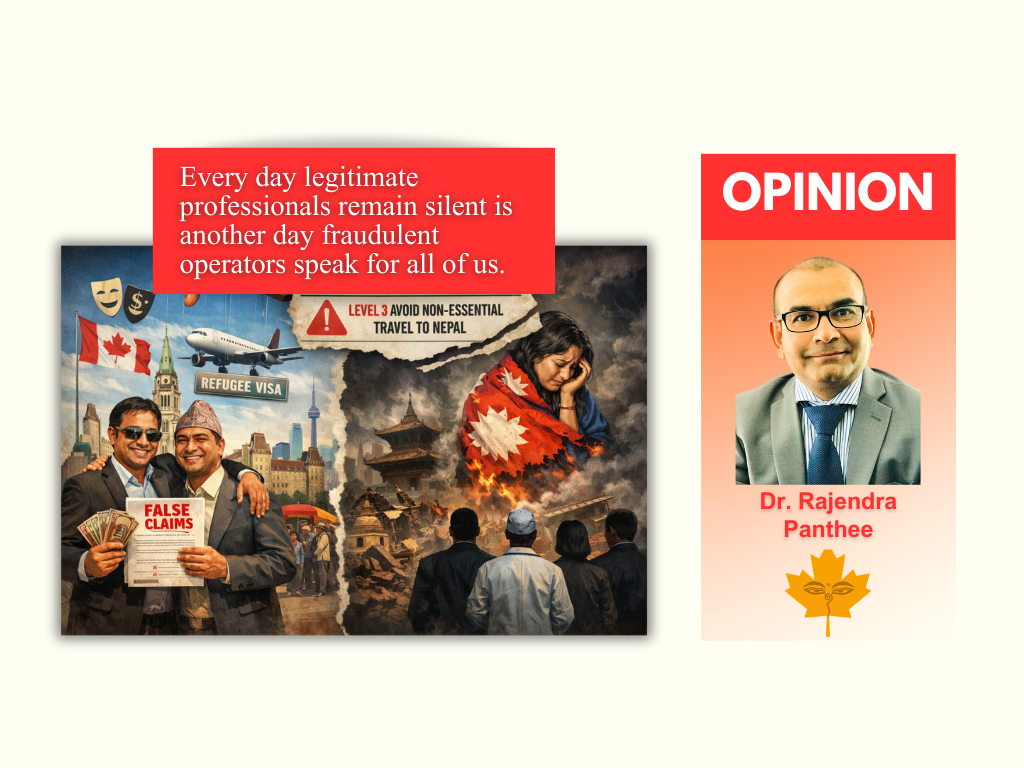
When Canada issued its Level 3 travel advisory for Nepal on December 12, 2025, following the Gen Z protests in September, my colleague Nirupama Sharma wrote a thoughtful piece in Nepal Touch expressing the shock many of us felt. She concluded with what seems reasonable: Can't the Nepali embassy and community organizations help improve Nepal's image?

The short answer to Nirupama's question is no, not as long as the current power dynamics remain unchanged. While this particular advisory stems from the Gen Z movement, there's a deeper crisis that has been systematically tarnishing Nepal's reputation in Canada for decades. The people who dominate "Nepali community representation" are often the very same people whose presence here is built on fabricated stories of persecution in Nepal. Coming from political or ethnic organizational backgrounds in Nepal, they either founded various organizations in Canada to create their own visibility or were deployed by political parties and ethnic groups back home to expand their reach abroad.
The Myth I Believed
When I applied for Canadian permanent residency through the high-skilled worker category while completing my PhD, I believed Canada's system was merit-based. Then I arrived in Mississauga, Ontario. The myth shattered.
I watched people celebrate ecstatically when their refugee claims were approved. These were people who had entered as visitors and filed fabricated asylum claims. Meanwhile, physicians drove taxis. Engineers worked at Tim Hortons. The people who came through fake refugee claims were thriving. The people who came through legitimate channels were miserable. The Canadian government had no plan for utilizing their skills, forcing them to upgrade credentials or change professions entirely. This wasn't a problem for those who used the fake refugee route because they never expected to use their previous credentials anyway.
The Integrated Business Model
Last year, I published an analysis of "the dark side of cultural entrepreneurship" in the Nepali-Canadian community. The response was telling: overwhelming support from ethical members, furious backlash from those whose business models I'd exposed.
Dr. Punya Sagar Marahatta identified this pattern years ago. He wrote about monopolistic control over artist invitations and suspicious correlations between cultural events and refugee claims. Nepal Touch's executive editor Jayram Gautam and Lok Doranga, a Scarborough realtor and driving instructor, observed the market saturation. They noted so many poorly organized events with sparse audiences.
The system is simple. When a Nepali singer performs, organizers compile lists of people willing to pay $15,000 to $25,000 to come as part of the "artist's group." They get visitor visas, attend the concert, and immediately file refugee claims. Then they need an immigration professional. Conveniently, it's often the same person who organized the concert.
It's a complete ecosystem. The event company brings them in. The immigration consulting firm processes refugee claims. The community organization provides settlement services. The cultural association gives community integration credentials. One network, multiple revenue streams, all dependent on people claiming Nepal is too dangerous to return to.
The Perverse Loyalty Test
Here's the bitter irony. To prove you're a "real Nepali," you must financially support the very people destroying Nepal's reputation.
These operators frame events as "promoting Nepali culture and artists, business and so on." Attendance becomes a loyalty test. Don't buy those expensive tickets? You're disconnected from your roots. Question their motives? You're jealous or divisive.
The same people who exploit the motherland Nepal are building businesses on fabricated persecution stories while positioning themselves as champions of Nepali culture. Those who truly love Nepal, who would never tarnish the motherland's image for personal benefit, face an impossible choice: fund the smuggling operations or face social consequences.
The fake patriots are easy to identify. They constantly post about promoting Nepali culture while coaching persecution stories. They organize cultural events while running smuggling operations. Those who genuinely love Nepal show it through quiet integrity. Those who betray Nepal for profit perform their patriotism loudly, demanding others prove loyalty by funding operations that harm the motherland.
Student Targeting and Organizational Corruption
The industry now systematically targets international students. Consultants approach students whose study permits are nearing expiration: "File a refugee claim. You'll get PR faster." These are coached claims. This became so widespread among Indian students that Canadian authorities deported numerous individuals.
The proliferation of Nepali organizations in Canada tells its own story. Not all organizations are involved in fraudulent activities. Many were founded with genuine intentions. However, one key reason for the explosion of organizations is that individuals want to be heads of organizations they can then misuse for personal benefit. News regularly surfaces about letterhead misuse or internal fights when these practices are exposed. When fraud is exposed, innocent board members often become scapegoats while actual perpetrators remain protected.
Who Gets to "Represent" Nepal?
When I shared on Facebook that I was writing this, Dr. Marahatta highlighted an important concern: when genuine professionals remain silent, a small number of fraudulent actors can end up shaping how Canadian institutions view the broader Nepali community.
When officials want to understand the Nepali community, they meet the visible networks. The ambassador meets with them. Politicians take their briefings. Their narratives shape policy decisions and institutional understanding of who Nepalis are. Every time a fraudulent consultant briefs a politician, they're speaking for every Nepali doctor, engineer, and professor in Canada.
Why Embassy Advocacy Cannot Fix This Alone
This brings us back to Nirupama's question. Can the embassy and community organizations help?
The embassy faces an impossible structural problem. They cannot publicly call out fraud in the diaspora or refuse to meet with visible community organizations. When they present positive information about Nepal, they're immediately countered by community representatives whose businesses depend on Nepal maintaining a negative image. The people with the most access to the embassy are precisely the ones with the strongest incentive to misrepresent Nepal.
As for community organizations, while not all are corrupt, many have been compromised. Organizations sell letterheads to support false refugee claims. The embassy and organizations cannot fix this alone without genuine professionals stepping forward to reclaim representation.
A Warning and A Call to Action
So to answer Nirupama directly: No, the embassy and current community organizations cannot effectively improve Nepal's image as long as fraudulent operators monopolize community representation. But yes, there is hope if genuine professionals break their silence.
The current travel advisory reflects the Gen Z protests. But there's a deeper threat. If the decades of fake refugee claims, concert-based human smuggling, and predatory targeting of students continue, they will one day be fully exposed to the Government of Canada. That day will fundamentally change how all Nepali-Canadians are perceived.
When Canadian authorities investigated Indian student fraud, the consequences were severe and collective. Deportations, increased scrutiny, and damaged community reputation affected even legitimate Indian-Canadians. The patterns in the Nepali community are accumulating. It's not whether Canadian authorities will investigate, but when.
When that day comes, every legitimate Nepali in Canada will face consequences. Our children will face discrimination. Our professional credentials will be questioned. The entire Nepali-Canadian identity will be tainted by fraudulent operators who claimed to represent us.
To those who genuinely love Nepal: This is urgent. The human smuggling and fabricated stories are systematically destroying how Canada perceives Nepal. Dr. Marahatta has been warning about this for years. The time for silence is over.
Your silence isn't protecting your reputation. It's ensuring you'll be caught when the fraud is exposed. The government of Canada will eventually discover the full scope of what's been happening. Whether we can prevent or mitigate that collective damage depends on whether genuine voices emerge now.
The answer to Nirupama's question depends entirely on whether we, the genuine lovers of Nepal who would never tarnish the motherland's image for personal gain, are willing to break our silence. The clock is ticking. The exposure is coming. The question is whether we act before or after that day of reckoning.
The Author is an Associate Teaching Professor at Syracuse University, New York.
.gif)

 सम्बन्धित खबर
.png)

.png)



.png)







तपाईंको प्रतिक्रिया