

.jpeg)
Action Over Rhetoric: Gagan Thapa's Carney Moment and Nepal's Political Transformation
Dr. Rajendra K. Panthee
.gif)
In January 2026, Canadian Prime Minister Mark Carney stood before the World Economic Forum in Davos and delivered a message that resonated far beyond economics: "The time for talking is over. We need action." But here's what makes Carney's story remarkable: just months before he became Prime Minister, the Liberal Party wasn't even on Canada's political horizon. Despite winning elections over the years, including Trudeau's minority government, the Liberals were hemorrhaging support. Housing crisis, cost of living pressures, and immigration concerns—problems largely resulting from post-COVID global economic disruption rather than Liberal policy failures—had turned voters against them. Conservative leader Pierre Poilievre appeared unstoppable in polls. Then Carney entered, took Liberal leadership, and within months completely transformed Canadian politics. Today, Conservatives aren't expected to return to power anytime soon.

Around the same time, Nepal's newly elected Congress President Gagan Thapa addressed his party's special convention with similar themes: Nepal needs leaders who act, not just promise. Just as Canadians had written off the Liberal Party until the right leader emerged, many Nepalis have written off Congress after three decades of broken promises. Yet Gagan's early actions suggest he might attempt what seemed impossible—transforming Nepal's most failed political institution into a vehicle for genuine change.
The question isn't whether Congress deserves another chance. After thirty years of self-inflicted corruption and dysfunction—problems far more damning than Trudeau's circumstantial challenges—it clearly doesn't. The question is whether Gagan Thapa represents a break from that history.
The Carney Model: Transforming Declining Institutions
Carney didn't build a new party. He took an institution voters had soured on and transformed it through decisive action. Within his first hundred days, he'd repaired Canada's frozen diplomatic ties with both India and China, eliminated interprovincial trade barriers, and forced competing provinces to cooperate. He chose Canada's national interest over group demands, demonstrating that leadership means making difficult decisions even when they disappoint vocal constituencies.
Carney didn't build a new party. He took an institution voters had soured on and transformed it through decisive action.
Gagan faces an exponentially harder challenge. Carney revitalized a party suffering from voter fatigue over circumstantial economic problems. Gagan must transform a party that failed consistently for three decades through deliberate choices—enriching leaders while infrastructure crumbled, appointing loyalists throughout the justice system, protecting each other from accountability, and creating the dysfunction that sparked September 2025's Gen Z uprising.
Early Evidence: Ticket Distribution as Test
Under Gagan's leadership, Congress has sidelined numerous senior leaders who've dominated for decades, bringing forward new faces and younger candidates for March 2026 elections. This wasn't symbolic reform—it was immediate, observable transformation.
This ticket distribution represents the most concrete test of whether Gagan means business. The senior leaders he's sidelined have deep patronage networks, financial resources, and loyal supporters who could create internal chaos. These are the same figures who made Congress synonymous with corruption for thirty years. Yet Gagan pushed through generational transition anyway, using his mandate as party president to restructure candidate selection before elections.
Whether this proves genuine reform or mere window-dressing will determine Congress's fate. But it's concrete action, not just rhetoric—something desperately needed after decades of broken promises.
The Balen Alternative: Frustration Without Foundation
Right now, RSP led by Rabi Lamichhane and Balen Shah looks formidable—much like Poilievre's Conservatives appeared unstoppable before Carney emerged. But here's the crucial insight: Rabi and Balen's rise represents pure frustration with traditional parties, not any genuine foundation or history of their own. RSP has no institutional depth, no track record of governance, no established policy expertise—just channeled anger at a failed system.
Narayan Wagle's analysis reframes the debate: "The question isn't Balen—it's ourselves." Are voters engaging in wishful thinking, projecting hopes onto charismatic figures without evaluating actual capacity?
Sudip Shrestha's detailed Setopati examination documents Balen's three-year Kathmandu tenure: waste management systems never materialized, incineration projects were abandoned, waste segregation never happened, and job creation claims proved empty. Most telling: Kathmandu Metropolitan City recorded the lowest capital expenditure among major municipalities despite having Nepal's largest budget—revealing massive gaps between rhetoric and implementation.
Shrestha documented authoritarian patterns: bulldozers against street vendors without alternatives, conflicts with ward chairpersons, refusal to consult other mayors or federal government, and threats to "burn down Singha Durbar" over a traffic incident. Balen's recent shifts—from claiming "Suryavanshi royal family" heritage to "son of Madhesh," from opposing federalism to embracing it, promising 10 million tourists to Janakpur despite Nepal receiving only 1 million total—reveal calculation over principle.
Political analyst Arun Baral's work on populist frameworks explains Balen's appeal despite these failures. Populism thrives on charismatic leaders channeling frustration while avoiding concrete accountability. Balen excels at identifying problems and generating headlines but struggles to build bureaucratic machinery that transforms vision into reality.
Why Political Journey Matters
Carney's background in economic policy and bureaucratic navigation allowed decisive action once he had authority. Gagan brings similar depth through his political journey: student politics, grassroots organizing, legislative processes, managing party factions, now leading a major national party. At each stage, he developed essential governing skills—building coalitions, negotiating with opponents, managing competing interests within democratic frameworks.
Balen lacks this entirely. Three years running one municipality with authoritarian instincts hardly qualifies as preparation for governing Nepal's complex democracy, managing 753 local units, navigating India-China geopolitics, or building parliamentary coalitions.
The "inevitable" RSP wave built purely on frustration could recede just as Conservative momentum collapsed once voters saw genuine reform from an unexpected source.
More importantly, Gagan's experience taught him how to transform institutions from within—exactly the skill required to reform Congress. RSP built on frustration rather than foundation offers no such capacity. When anger subsides, what institutional strength remains to actually govern?
The Transformation Timeline
Perhaps the most encouraging lesson from Canada is how quickly genuine transformation occurs once the right leader takes charge. Just months ago, Liberals looked finished despite years of electoral success. Today, they've reversed Canadian politics because Carney demonstrated concrete results, not inspiring speeches.
If Gagan continues demonstrating genuine Congress transformation—if new candidates perform well, if he maintains independence from sidelined senior leaders, if he delivers even partial reform results—Nepal could witness similar rapid reversal. The "inevitable" RSP wave built purely on frustration could recede just as Conservative momentum collapsed once voters saw genuine reform from an unexpected source.
What Nepal Needs
The question isn't whether Nepal needs change—it absolutely does. The question is which path produces sustainable transformation: personality-driven movements with no governing capacity or foundation beyond channeled anger, led by figures with troubling authoritarian instincts like Balen, or transforming established institutions under new leadership combining fresh vision with expertise to actually govern.
Carney chose to transform Liberal institutions—and within months reversed Canadian politics. Gagan is attempting the same Congress transformation. Whether he succeeds depends on factors beyond anyone's control—whether party machinery truly allows transformation, whether new candidates prove competent, whether voters give reformed Congress a chance despite justified anger.
But as Carney proved, never underestimate what the right leader can accomplish by transforming established institutions. The Canadian experience suggests that sometimes the most unlikely transformations—reviving parties voters had soured on—produce the most sustainable change.
RSP's rise reflects legitimate frustration but offers no foundation for actual governance. Rabi and Balen channel anger effectively but lack the institutional capacity, policy expertise, or democratic experience that governing Nepal requires. When frustration inevitably fades, RSP's hollow foundation will be exposed.
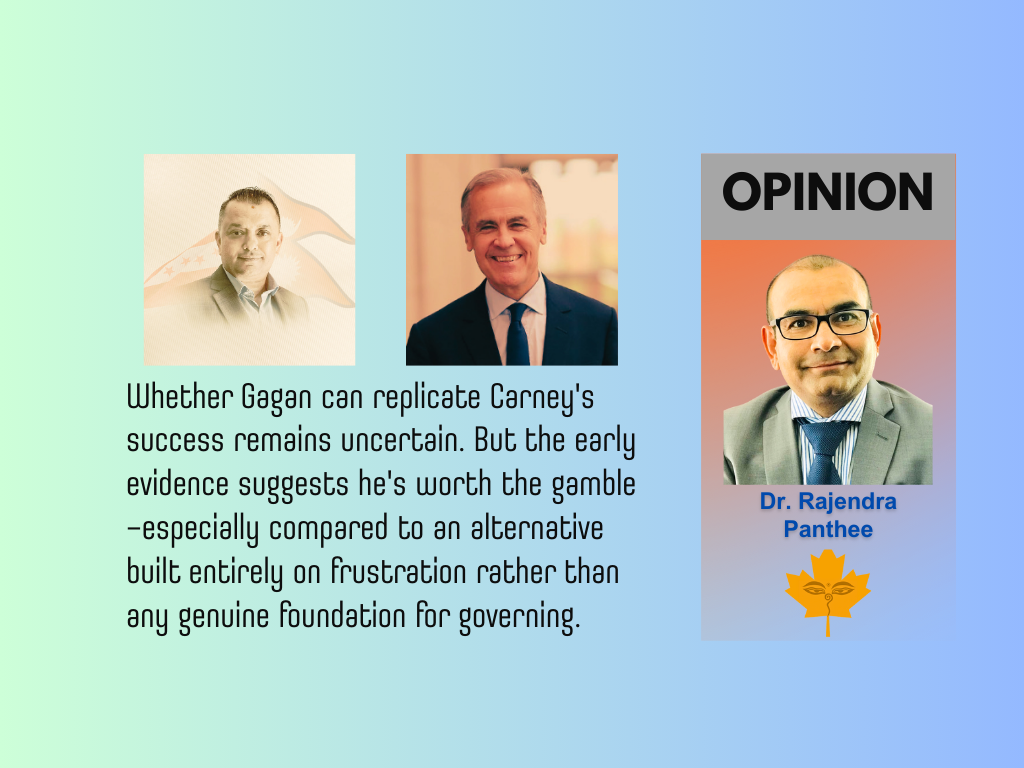
Gagan's experiment—transforming Congress from within—deserves a chance because the alternative offers neither institutional capacity nor genuine reform credentials. It offers only populist rhetoric that, as Wagle, Shrestha, and Baral document, rarely translates into functional governance. Whether Gagan can replicate Carney's success remains uncertain. But the early evidence suggests he's worth the gamble—especially compared to an alternative built entirely on frustration rather than any genuine foundation for governing.
-Brampton, Canada
The author is an Associate Teaching Professor at the Department of Writing Studies, Rhetoric and Composition at Syracuse University, New York, US
.gif)

 सम्बन्धित खबर










.png)
.png)



तपाईंको प्रतिक्रिया